The Story of Christian Punk
Feature Article
From Church Halls to Warped Tour
Loud guitars. DIY faith. Old flyers, church halls, Tooth & Nail samplers, ska horns, post-hardcore breakdowns and a scene that refused to stay tidy.
The rough map
Rez Band and the Jesus People roots
Undercover, Altar Boys, Lifesavors
Tooth & Nail, Dogwood, Ghoti Hook, Slick Shoes
Five Iron Frenzy and ska horns everywhere
Anberlin, Emery, Underoath, Beloved
Streaming, rediscovery and keeping the scene alive
Christian punk didn’t begin with MxPx.
It didn’t begin with Tooth & Nail Records.
It didn’t begin with Warped Tour, youth group compilation CDs, or somebody in a meeting saying, “This punk thing seems popular. Let’s stick a Jesus sticker on it and sell it to the church kids.”
That’s just not how this stuff works.
Punk isn’t only a sound. It’s an attitude. And you don’t get attitude without something behind it.
Aye, some folk just wanted to have fun and play in a band. Of course they did. That’s always been part of it. But punk has never only been about making a racket for the sake of it. It’s the way the racket is made. The DIY spirit. The “I’m not waiting for permission” energy. The feeling that if nobody’s going to hand you a platform, you’ll build one out of broken gear, borrowed amps and whatever space will let you make a noise.
Now pair that energy with faith.
Pair it with conviction.
Pair it with somebody who has something burning in their chest and no interest in dressing it up nicely for polite people.
That’s where Christian punk starts to make sense.
Not as a watered-down version of punk. Not as church music with louder guitars. Not as a safe alternative for parents who were worried about what their kids were listening to.
It came from people who loved the energy, honesty and urgency of punk, but had a different message to carry through it.
The voices could still be rough.
The guitars could still sound like they were being held together with tape and bad decisions.
The drums could still sound like someone trying to kick their way through a locked door.
But the message was different.
Not softer. Different.
Where some punk shouted that nothing mattered, Christian punk often shouted that everything mattered. Faith mattered. Doubt mattered. Grace mattered. Justice mattered. Sin mattered. Hope mattered. The world was broken, but it wasn’t abandoned.
This is the story of the old bands, the church halls, the samplers, the festivals, the labels, the UK underground, the ska explosion, the emo takeover, the metalcore invasion, and the moment Christian-rooted bands stopped standing at the edge of alternative music and started shaping it.
Before There Was A Scene
Before Christian punk had a name, Christian rock had already been picking fights with the polite end of church culture.
Resurrection Band, often shortened to Rez Band, came out of the Jesus People USA community in Chicago.
They weren’t punk in the strict sense, and we shouldn’t pretend they were just to make a neat timeline. Their roots were in hard rock and blues-rock.
But they mattered.
They proved that Christian music could be loud, gritty, serious and uncomfortable. They showed that faith-based music didn’t have to live in the safe, polished corner people expected it to stay in.
Source trail: Jesus People USA history.
That matters because scenes don’t usually appear out of nowhere.
They grow in cracks.
They grow where people are told, “That doesn’t belong here.”
They grow when somebody hears that sentence and thinks, “Aye, we’ll see about that.”
The First Wave: Give The Oldies Their Flowers
If you found Christian punk through Tooth & Nail samplers, Five Iron Frenzy shows, Dogwood records, Slick Shoes speed runs, Ghoti Hook hooks, or some battered CD your mate swore would change your life, there’s no shame in that.
A lot of people came in through the 90s and early 2000s. That was when the doors blew open.
But before the doors blew open, somebody had to start kicking at them.
These early bands weren’t playing to a world that had already decided Christian punk was a thing. They were helping make it a thing.
That’s a completely different job.
Undercover
Undercover are one of the names that need to be near the front of the queue.
They came out of Fullerton, California in the early 1980s, and they’re often described as pioneers in what later became alternative music in the Christian world. Their early sound had punk and new wave energy, but what really matters is where they stood. They were doing something most Christian music didn’t know how to handle yet.
They weren’t just louder than a lot of the Christian music around them.
They were operating with a different spirit.
Short songs. Urgency. Rough edges. Faith without the usual packaging.
The Altar Boys
The Altar Boys came out of Southern California in the early 1980s and brought a proper early Christian punk sound into the scene. They were explicit about faith, but they weren’t trying to make punk polite. They had speed, energy and that sense that the song might fall apart if everyone didn’t keep running.
They mattered because they gave Christian punk one of its early templates: fast, direct, faith-filled, and not especially interested in smoothing itself down for the room.
The Lifesavors
The Lifesavors, tied to Michael Knott, sit in that strange early space where punk, new wave, alternative and Christian underground music were all crashing into each other.
They matter because they sit right at the beginning of this thing, before there was a neat category to drop them into.
And Michael Knott matters because he didn’t stay in one lane. He became one of those restless figures who made Christian alternative music feel less predictable, less safe, and much more interesting.
Scaterd Few
Scaterd Few are one of the great “this shouldn’t work but somehow it does” bands.
They weren’t tidy. They weren’t easy. They weren’t trying to fit into the safe version of Christian music.
They mixed punk with stranger, darker and more alternative elements, and that’s exactly why they mattered. They were part of the early Christian punk world, but their music didn’t always sit comfortably with polite Christian culture.
Good.
Sometimes honest music makes polite people nervous.
One Bad Pig
One Bad Pig were chaos with a microphone.
They brought humour, hardcore punk energy and a sense that the whole thing might fly off the rails at any moment.
Some bands make you think, “This is musically important.”
One Bad Pig make you think, “Somebody’s getting banned from the church hall tonight.”
And that is also important.
Crashdog
Crashdog brought Chicago grit into the story.
They came from the Jesus People USA world, the same broader orbit as Rez Band and Cornerstone, but their thing was much more rooted in punk energy and blunt social commentary.
Crashdog mattered because they weren’t only singing “Christian songs” in a punk style.
They were taking on politics, injustice and social issues with the volume turned up.
That opened another door.
Lust Control
Lust Control were awkward, controversial and impossible to ignore.
They were one of those bands where the conversation around them almost becomes part of the band itself. They dealt with subjects that Christian music often preferred to avoid, and they did it with all the subtlety of a brick through a window.
Were they tasteful?
Not always.
Were they comfortable?
Absolutely not.
But Christian punk was never only about making everyone comfortable.
The Crucified
The Crucified helped drag Christian punk and hardcore toward something heavier.
They sit in that important bridge between punk attitude and metal aggression. Without bands like The Crucified, it’s harder to imagine the later Christian hardcore, metalcore and heavy underground scenes developing the way they did.
They helped build a bridge.
And once that bridge was built, a lot of very loud bands walked across it.
The Underground Before The Internet
It’s hard to explain to younger readers how scenes used to work before everything was searchable.
You didn’t just type “Christian punk bands like Dogwood” into Spotify and get a playlist before your toast popped up.
You found music through effort, accident and obsession.
A mate handed you a cassette.
Somebody at church had a CD you’d never seen before.
A youth leader played something weird and half the room hated it.
You bought an album because the cover looked dangerous or super cool .
You read tiny reviews in magazines.
You ordered something by mail. And when it arrived a few weeks later, you hoped it wasn’t rubbish.
You went to a gig in a church hall where the sound was terrible, the lights were worse, and somehow it still changed your life.
That’s the soil Christian punk grew in.
The thing that connected these bands wasn’t a uniform. It wasn’t one sound. It wasn’t one haircut.
It was the attitude.
A faith-shaped refusal to shut up.
Explore Early Christian Punk And Hardcore
The UK Story Deserves More Digging
A lot of the Christian punk story gets told as if America was the whole map.
It wasn’t.
America had the labels, the festivals, the magazines and eventually the machinery to document more of it. Tooth & Nail, Cornerstone, HM, 7ball, all that stuff gave the American scene a paper trail.
The UK story is harder to follow because a lot of it was smaller, scrappier and more local.
But that doesn’t mean it wasn’t there.
And because this is being written from Scotland, we can’t just tell the story as if everything important happened in California, Chicago and Florida.
Scotland belongs in this story too, even if the trail is harder to follow.
Not as some grand claim that Glasgow, Edinburgh, Aberdeen or anywhere else was the centre of Christian punk history. They weren’t. But there were people here trying to make something happen. There were gigs, youth events, links pages, borrowed halls, old forums, demo CDs, and all the usual scrappy bits that scenes are made from.
That’s the problem with local underground history. If nobody writes it down, it starts to vanish.
Reading had Cephas, another UK band who captured the tension well. In a Cross Rhythms interview, the band spoke about being stuck between secular punk on one side and a UK Christian music scene they felt was years behind on the other. That’s basically the Christian punk problem in one sentence. Source
There were other names too. Zedisforzebra. Decapolis. Cheddleton. Subonyx. Standing Room Only.
Some of them appeared on the UK Christian punk compilation Bulldogs And Safety Pins, the kind of release that reminds you there was a scene here, even if most of it never got properly documented online. Source
These weren’t bands with massive publicity machines behind them.
They were part of the under-documented UK underground, the kind of scene that survives in compilation CDs, local gigs, old flyers and half-remembered stories.
And then there’s the wonderfully strange Blaster the Rocket Man connection.
Blaster were one of America’s great Christian punk oddities. Horror punk. Sci-fi punk. Surf punk. Songs that sounded like somebody had fed old monster movies, C. S. Lewis and a broken guitar into the same machine and then kicked it down the stairs.
After Blaster, Otto Bot formed Voice of the Mysterons in Scotland, giving the story a strange wee transatlantic thread.
That doesn’t make Scotland the centre of Christian punk history.
But it does make the story feel less distant.
The underground travelled in odd ways. Bands split. People moved. New projects appeared. Scenes overlapped. Someone who started in American horror-punk could end up making strange, dark, noisy music over here.
That’s exactly the kind of thread Waken The Dead should be pulling on.
The UK part of the story needs more digging. Proper digging.
Who were the bands playing church halls in Glasgow, Birmingham, London, Manchester, Belfast, Cardiff, Aberdeen and all the places nobody wrote down properly?
Who still has the flyers?
Who has the demo tapes?
Who remembers the support bands?
Who saw a group once at a youth event and never found their name again?
That’s not just nostalgia.
That’s history.
And if nobody records it, it disappears.
Help Fill The Gaps
Were you in a UK Christian punk, ska, hardcore or emo band? Got flyers, demos, old photos or stories? Send them in. This history is worth saving.
Wake N The Dead And The Old Web
This is also where Waken The Dead has its own small place in the story.
Back in the early 2000s, the site was Wake N The Dead.
Not a polished platform.
Not a brand strategy.
Just one of those little scene sites that existed because somebody cared enough to build it.
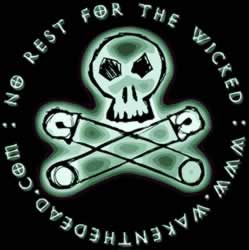
The Wayback Machine has captures of the site going back to 2002, and an archived version from September 2004 shows the old Wake N The Dead homepage with a message board, people’s photos, an art gallery, audio section, theology library, links, and references to bands including Blaster The Rocketman and Beloved. Archived page
The old arrival logo wasn’t the polished heart-and-pins mark the site uses now. It was a skull and crossed safety pins, wrapped in the words “No Rest For The Wicked” and the old Wake N The Dead web address.
Rough, homemade, and exactly the sort of thing an early-2000s punk scene site should have looked like.
Nothing massive.
Nothing corporate.
Just people sharing music, talking faith, posting links, finding bands and keeping the noise alive in their own corner of the internet.
That’s worth mentioning, not as some big self-important claim, but because it shows the heart of what these scenes were like.
Small sites. Local connections. Shared music. Faith conversations. Weird band links. People trying to keep track of something that mattered to them before the internet got tidied up and monetised to death.
Cornerstone And Finding Your Tribe
For a lot of people, Christian alternative music wasn’t just about records.
It was about finding your tribe.
Cornerstone Festival became one of the major gathering points for the underground Christian scene. JPUSA says Cornerstone Festival ran for 29 years, from 1984 to 2012, and drew up to 20,000 attendees each summer. Source
That mattered.
Because if you were the only punk kid in your church, or the only Christian in your punk scene, places like Cornerstone told you something powerful.
You’re not the only one.
There are more of us.
They have worse haircuts than you.
And some of them have brought amps.
That might sound daft, but it’s not. Scenes aren’t built by music alone. They’re built by people realising they’re part of something. They’re built when someone looks around a room and thinks, “Hold on. I fit here.”
Then Tooth & Nail Happened
By the time Tooth & Nail Records appeared in 1993, the underground had already been rumbling for years.
But Tooth & Nail changed the scale.
Founded by Brandon Ebel in 1993, Tooth & Nail became one of the most important labels in Christian alternative music. The label sat right at the crossroads of Christian music and underground subcultures like punk, emo, post-hardcore, metalcore and alternative rock. Source
This was the moment the scene got connected.
Suddenly, bands that might once have felt like isolated oddities were part of something bigger. The label gave people a way in.
You bought one Tooth & Nail record, then another, then a sampler, then suddenly you had a whole new world to explore.
This was dangerous for your bank account.
But excellent for your soul.
The 90s didn’t belong to one band. That’s the mistake people make when they flatten the scene into a greatest-hits version of itself.
The explosion was bigger than that.
Ghoti Hook brought melody.
Dogwood brought grit.
Slick Shoes brought speed.
Craig’s Brother brought heart.
Value Pac brought scrappy pop-punk charm.
Five Iron Frenzy and The O.C. Supertones brought horns, chaos and ridiculous amounts of energy.
MxPx were part of that wave, absolutely.
But they weren’t the whole wave.
Ska Arrived With Horns Blazing
For a few brilliant years, it felt like every Christian youth group had at least one trumpet player and three boys in trousers wide enough to camp under.
Ska went massive.
Five Iron Frenzy formed in Denver in 1995 and became one of the defining names in Christian ska-punk. They were known for ska-punk, humour and Christian themes, and they came out of the same 90s ska revival that sent horns blasting through alternative music everywhere.
The O.C. Supertones brought their own high-energy version of Christian ska into the scene.
The Insyderz were there.
The Dingees were there.
Buck Enterprises were there.
And for a while, Christian ska wasn’t a side note.
It was everywhere.
It was fun, but it wasn’t empty. At its best, Christian ska carried joy, protest, mission, silliness and conviction all at once.
Explore 90s Christian Punk And Pop Punk
Pop Punk Became The Soundtrack
The 90s and early 2000s were when Christian punk became the soundtrack for a lot of teenagers who felt caught between worlds.
You had bands that sounded like the stuff your mates were listening to, but the lyrics were asking different questions.
Ghoti Hook had hooks for days.
Slick Shoes sounded like they were trying to outrun their own drummer.
Dogwood had grit under the fingernails.
Craig’s Brother carried a more thoughtful, wounded kind of melody.
Value Pac had that scrappy pop-punk charm.
The Huntingtons leaned hard into Ramones-style fun.
Hangnail brought tight, sharp songs that deserved more attention than they got.
Ninety Pound Wuss were stranger, sharper and more awkward than most people were ready for.
Blenderhead had that wiry, restless, punk energy that made the scene feel less predictable.
Squad Five-O brought a rawer rock-and-roll edge into the wider punk world.
This wasn’t one band carrying a scene.
It was a whole stack of bands giving kids different doors into the same noisy house.
Emo, Screamo And Post-Hardcore Crashed The Party
By the early 2000s, the scene changed again.
The skate punk and ska wave didn’t vanish, but something darker, heavier and more emotional started surging through.
Emo.
Post-hardcore.
Screamo.
Metalcore.
And this is where Christian alternative music did something remarkable.
For a few years, it wasn’t just copying the wider scene. Some of the most exciting bands in the wider scene had Christian roots, Christian members, or came through Christian labels and networks.
Anberlin. Emery. Further Seems Forever. Dead Poetic. The Juliana Theory. Watashi Wa. Underoath. Norma Jean. Zao. Living Sacrifice. Beloved.
This era was massive because the old boundary lines started getting blurry. Plenty of fans discovered these bands through mainstream channels, not Christian bookshops. They heard the songs first, then later found out the band had some connection to faith.
That changes everything.
Because suddenly Christian alternative music wasn’t hiding in a corner marked “safe substitute.”
It was standing shoulder to shoulder with the wider alternative scene.
Sometimes it was better.
And that’s not just scene loyalty talking.
Some of those albums still hold up with anything from that era.
When Christian Music Went Mainstream
There had been mainstream Christian crossover before, but the late 90s and early 2000s felt different.
P.O.D. had a huge mainstream rock moment with Satellite.
Switchfoot broke far beyond Christian radio.
Relient K crossed into the mainstream pop punk world.
Skillet became one of the biggest names in Christian rock.
And Underoath showed that a heavy band with roots in the Christian scene could stand on some very big stages indeed.
That’s the bit younger fans might not fully appreciate.
For a while, Christian-rooted alternative bands weren’t just doing well “for Christian bands.”
They were doing well full stop.
Magazine coverage. Major tours. Mainstream festivals. Big chart positions. Fans who didn’t care what section of the record shop the album came from.
The scene had gone from church halls and cassettes to the main stage.
The Metalcore Invasion
If punk opened the door, metalcore kicked the thing clean off its hinges.
Zao, Living Sacrifice and The Crucified had already helped lay foundations for heavier Christian underground music. Then came a wave of bands that made Christian metalcore impossible to ignore.
Underoath. Norma Jean. August Burns Red. As I Lay Dying. For Today. Phinehas. Demon Hunter.
The scene got heavier, more technical, more intense and more global. Labels like Solid State Records and Facedown Records became hugely important in shaping the sound and culture.
This wasn’t polite music for polite people.
It was breakdowns, screams, double kick drums and lyrics that wrestled with sin, suffering, surrender, hypocrisy, holiness and hope.
And somehow, for a generation of fans, it made perfect sense.
Because the emotional core had always been there.
The guitars just got heavier.
Explore Christian Hardcore And Metalcore
New To The Scene? Start Here
If you’re new to Christian punk, hardcore, ska or emo, don’t worry about trying to learn the whole family tree in one go. The easiest way in is to start with what you already love, then follow the thread from there.
Don’t treat these as perfect one-to-one swaps. That’s not how music works. Everybody’s taste hits a bit differently. This is more like a recommendation from a mate. You mention a band you love, and they go, “Aye, have you checked out these folk?” That’s the idea.
Not copies. Not substitutes. Just starting points.
If you like Blink-182, try MxPx
Fast, melodic, catchy and one of the easiest entry points into Christian pop punk.
Also try:
Relient K Value Pac Hangnail Ghoti Hook
If you like Green Day, try Dogwood
A bit rougher round the edges, more bite in the delivery, but still packed with melody and energy.
Also try:
Slick Shoes Craig’s Brother The Huntingtons
If you like NOFX, try Ghoti Hook
Fast, fun, melodic and full of personality. Not a copy, but definitely the sort of band that can scratch a similar itch.
Also try:
Value Pac Slick Shoes Hangnail
If you like Rancid or Operation Ivy, try Five Iron Frenzy
Ska-punk chaos, brass, humour, heart and enough energy to wake the dead.
Also try:
The O.C. Supertones The Insyderz The Dingees Buck Enterprises
If you like Dead Kennedys, try Blaster the Rocket Man
Not because they sound exactly the same, but because they’ve got that weird, sharp, left-field punk energy that doesn’t care much about fitting in.
Also try:
Scaterd Few Lust Control One Bad Pig
If you like Bad Religion, try The Altar Boys
Direct, fast, clear in what they were doing, and hugely important to the early story of Christian punk.
Also try:
Undercover The Lifesavors The Blamed
If you like The Ramones, try The Huntingtons
Big hooks, simple songs, loads of fun, and no shame in wearing the influence right on their sleeve.
Also try:
The Altar Boys Value Pac Squad Five-O
If you like My Chemical Romance, Taking Back Sunday or Jimmy Eat World, try Anberlin
Big choruses, emotional weight, atmosphere, and songs that feel built for late-night headphones and staring out bus windows.
Also try:
Emery Further Seems Forever Dead Poetic The Juliana Theory
If you like Thursday or early Underoath, try Beloved
Heavy, emotional, raw and one of the most important bands in that Christian post-hardcore lane.
Also try:
Norma Jean Zao Living Sacrifice
If you like Killswitch Engage, try August Burns Red
Technical, heavy, relentless and one of the biggest names to come out of the Christian metalcore scene.
Also try:
Phinehas For Today Demon Hunter As I Lay Dying
If you like hardcore punk with a bit more chaos, try One Bad Pig
Loud, daft, wild and impossible to mistake for anybody else.
Also try:
Crashdog The Crucified Scaterd Few
You find one band.
Then another.
Then another.
Then before you know it, your shelves, playlists and T-shirts are telling a whole story.
The Streaming Era And The Long Tail
Then the internet changed everything again.
The old gatekeepers weakened.
The Christian bookshop wall disappeared.
The magazine rack disappeared.
The compilation CD became a playlist.
The fanzine became a blog.
The forum became social media.
The demo tape became Bandcamp, Spotify, YouTube and whatever platform the kids are using by the time you finish reading this.
That shift brought losses and gains.
On one hand, the old sense of scene could feel harder to find. Everyone had access to everything, but somehow it could feel less connected. You no longer had to hunt for a band, but you also lost some of the magic of discovering something because a mate pressed a CD into your hand and said, “Trust me.”
On the other hand, independent bands could reach people without waiting for a label to notice them. Old bands could be rediscovered. Forgotten records could be reissued. Scene history could be pieced together by people who cared enough to dig.
That’s where Waken The Dead fits.
Not as some big shiny media empire.
Just as one more place trying to reconnect the dots.
The old bands. The new bands. The labels. The scenes. The genres. The stories. The reason this music mattered in the first place.
Why It Still Matters
Christian punk matters because it gave people permission.
Permission to love loud music and still take faith seriously.
Permission to be honest about doubt.
Permission to say church culture wasn’t always the same thing as Jesus.
Permission to be angry without becoming empty.
Permission to be hopeful without becoming soft.
Permission to admit that life is messy, faith isn’t always neat, and sometimes the most honest prayer sounds like feedback from a badly wired amp.
The scene was never perfect. No scene is.
It had its ego. Its arguments. Its contradictions. Its bands that burned bright and disappeared. Its labels that rose, changed and sometimes broke hearts. Its fans who got older and discovered that stage-diving and lower back pain are not natural friends.
But at its best, Christian punk and the wider Christian alternative scene created something rare.
A place for people who didn’t fit neatly.
A place where faith wasn’t reduced to slogans.
A place where songs could be messy, loud, wounded and still somehow full of grace.
That’s why the old bands deserve their flowers.
Undercover. The Altar Boys. The Lifesavors. Scaterd Few. One Bad Pig. Crashdog. The Blamed. Lust Control. The Crucified. The Predators. Cephas. Zedisforzebra.
The forgotten UK church hall bands.
The cassette-demo heroes.
The ones who played before there was a crowd waiting.
The ones who made it possible for the next wave to find a crowd.
Christian punk didn’t come from nowhere.
It came from people with guitars, questions, conviction and enough volume to annoy the neighbours.
Different spelling now.
Different internet.
Same heartbeat.
Find the bands.
Share the noise.
Share the joy.
Support your scene.