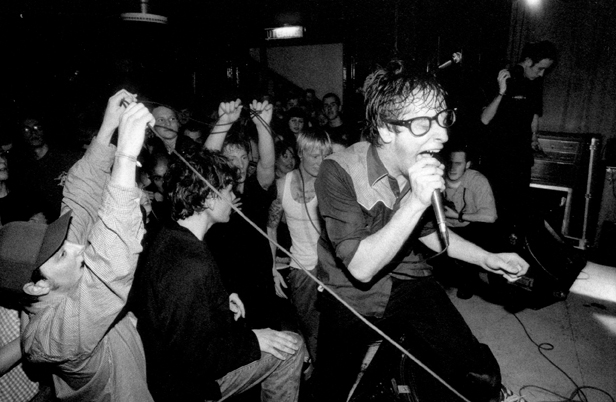
Frodus quick facts
Are you in this band?
Help us get the facts right.
Open this panel to load the private contact form.
Frodus (a.k.a. Frodus Conglomerate International, Frodus Sound Laboratories, FCI, Frodus Escape Plan, Frodus Deposit Insurance Corporation) was an American post-hardcore band formed in 1993 in Washington, D.C. by vocalist/guitarist Shelby Cinca and drummer Jason Hamacher. The band went through numerous bassists over the course of their career. Their mixture of math rock and hardcore punk plus their lyrical themes, frequently dark and dissonant and seen as esoteric for the time, led them to be described by critics as one of the most influential post-hardcore bands of the 1990s.
Biography
Existence (1993–1999)
Frodus’ first releases were self-distributed cassettes and 7”, such as Babe, Tzo-Boy, and Molotov Cocktail Party. Two other releases (Fireflies and F-Letter), on since-defunct indie labels, followed. The name “Frodus” came from the last episode of TV series The Monkees called “Mijacogeo” (a.k.a. “The Frodis Caper”).
Frodus later signed with Tooth & Nail Records, an independent label out of Seattle, with whom they released Conglomerate International in 1998. The band broke up on December of 1999.
Most of Frodus’ recognition was due to their final release, And We Washed Our Weapons in the Sea, recorded in 1999 and released in 2001 on Fueled by Ramen, considered by band members to be their best recorded work.
Post-breakup (2000–2008)
After Frodus broke up in 1999, it took two years to find a label to release their final album. The first label, MIA Records, shut down due to the owner (also a Texas oil-tycoon) having to settle a long-standing lawsuit. Afterwards, long-time Frodus friend Tony Weinbender (then of Fueled by Ramen Records) offered to release Frodus’ final album.
Shelby Cinca briefly joined the band Bluebird as a second guitarist following the breakup of Frodus, but left before recording any material with them. In 2000, Nathan went on to form The Out Circuit and Night Is Invisible (both of which released records on Lujo Records), and Hamacher went on to drum for Combatwoundedveteran. In 2003, the founding members Shelby Cinca and Jason Hamacher along with bassist Joe Lally of Fugazi joined to form The Black Sea. They later changed their name to Decahedron. Lally left shortly after the completion of their debut album and was replaced by Jonathan Ford (Unwed Sailor, Roadside Monument). Continually plagued by bassist fluctuation anomalies, Ford quit in 2004 and was later replaced by Jake Brown (formerly of Moments in Grace and Twothirtyeight). In 2005, they suspended operations after the release of their EP entitled 2005. Shelby Cinca then focused on his Swedish project Frantic Mantis with Håkan Johansson and Per Stålberg of Division of Laura Lee, and completed the third album by The Cassettes (Buddyhead Records, 2006). In 2006, Jason Hamacher started a project with Mike Schliebaum of Darkest Hour called Zealot. Cinca began releasing IDM, made on a Game Boy (Game Boy music) with the Nanoloop software, under his own name.
2006 also saw the relaunch of the Frodus web-presence and consolidation of its MySpace entities. The site was an attempt to archive all known interviews, previous website designs, press clippings, and digital transfers for media content. Shelby Cinca also began remastering out-of-print releases and adding them to the iTunes library and other digital music services through his partnership with Carcrash Records.
Reunion (2009–2010)
2009 saw Frodus reunite as the Frodus Escape Plan/Frodus Conglomerate International/FDIC (Frodus Despotic (or Deposit) Insurance Corporation) with Liam Wilson from The Dillinger Escape Plan on bass, and Jake Brown also on bass for select appearances. The reunion was organized in commemoration of the re-release of the Conglomerate International double-vinyl LP on Gilead Media, and as a statement in response to the bank-bailouts and the uncovering of corporate corruption in the financial sector.
In 2010, Frodus released a new 7″ of material, Soundlab 1, recorded in 2009 with Liam Wilson on bass, released exclusively as a digital download on Bandcamp and as a limited edition 7″ vinyl on Lovitt Records. According to Cinca, the Soundlab series was meant as a series of collaborations with different musicians, which could potentially be its own project outside of Frodus. A statement from the band announced that future collaborations could feature members of such bands as Refused, Darkest Hour, Engine Down, Norma Jean and Converge.
A reissue of the band’s final album, And We Washed Our Weapons In the Sea, was released on Lovitt Records in 2015.
Frodus
WTD context: Christians in the band, not a Christian band
Frodus appears on Waken The Dead as a rare scene exception. The band had Christian members and spent part of its career on Tooth & Nail Records, so Frodus has often been grouped with Christian alternative music. The band itself was explicit, however, that it did not identify as a Christian band. That distinction is important: the Christian connection belongs to members and scene history, not to Frodus as a ministry act or to a claim that its lyrics were Christian.
That ambiguity followed Frodus during its Tooth & Nail years. In a 1998 interview preserved in the band’s own archive, Shelby Cinca addressed the assumption directly and said Frodus did not want listeners misled into thinking it was a Christian band. The group also said it did not build its touring around Christian shows. A later interview from the same archive makes the personal side clearer. Jason Hamacher described himself and the guitarist as Christians while noting that the bassist was not, and said spirituality was not a major subject in the band’s lyrics or live presentation. Political, technological, business and personal themes were much closer to the band’s public identity.
The Tooth & Nail relationship therefore fits better as part of Frodus’s label and scene history than as a genre or faith classification. The band worked with the label because of practical support, distribution and the willingness of people at Tooth & Nail to back music that sat outside the company’s better-known Christian-market catalogue. Period interviews show that Frodus knew the association would lead some listeners to assume a Christian identity, but the members repeatedly corrected that assumption. In another 1998 interview, the band said that signing with Tooth & Nail had not changed what Frodus was.
That outsider position suited the wider Frodus aesthetic. Emerging from the Washington, D.C. underground in the 1990s, the band fused post-hardcore, noise rock and angular, rhythmically restless writing with a deliberately strange conceptual framework known as the Frodus Conglomerate. Shelby Cinca later described the Conglomerate as a subversive organisation operating inside modern corporate society, using music to question the framework around it. Corporate language, technology, conspiracy, consumer culture and institutional power became recurring pieces of the band’s imagery.
For WTD, the distinction is straightforward. Frodus has a legitimate connection to Christian alternative music history through Christian members, Tooth & Nail and overlapping musicians and scenes, but the band should not be described as a Christian band. Their inclusion here reflects that historical connection and their importance to the broader post-hardcore world, while respecting how Frodus described itself.
Frodus
WTD context: Christians in the band, not a Christian band
Frodus appears on Waken The Dead as a rare scene exception. The band had Christian members and spent part of its career on Tooth & Nail Records, so Frodus has often been grouped with Christian alternative music. The band itself was explicit, however, that it did not identify as a Christian band. That distinction is important: the Christian connection belongs to members and scene history, not to Frodus as a ministry act or to a claim that its lyrics were Christian.
That ambiguity followed Frodus during its Tooth & Nail years. In a 1998 interview preserved in the band’s own archive, Shelby Cinca addressed the assumption directly and said Frodus did not want listeners misled into thinking it was a Christian band. The group also said it did not build its touring around Christian shows. A later interview from the same archive makes the personal side clearer. Jason Hamacher described himself and the guitarist as Christians while noting that the bassist was not, and said spirituality was not a major subject in the band’s lyrics or live presentation. Political, technological, business and personal themes were much closer to the band’s public identity.
The Tooth & Nail relationship therefore fits better as part of Frodus’s label and scene history than as a genre or faith classification. The band worked with the label because of practical support, distribution and the willingness of people at Tooth & Nail to back music that sat outside the company’s better-known Christian-market catalogue. Period interviews show that Frodus knew the association would lead some listeners to assume a Christian identity, but the members repeatedly corrected that assumption. In another 1998 interview, the band said that signing with Tooth & Nail had not changed what Frodus was.
That outsider position suited the wider Frodus aesthetic. Emerging from the Washington, D.C. underground in the 1990s, the band fused post-hardcore, noise rock and angular, rhythmically restless writing with a deliberately strange conceptual framework known as the Frodus Conglomerate. Shelby Cinca later described the Conglomerate as a subversive organisation operating inside modern corporate society, using music to question the framework around it. Corporate language, technology, conspiracy, consumer culture and institutional power became recurring pieces of the band’s imagery.
For WTD, the distinction is straightforward. Frodus has a legitimate connection to Christian alternative music history through Christian members, Tooth & Nail and overlapping musicians and scenes, but the band should not be described as a Christian band. Their inclusion here reflects that historical connection and their importance to the broader post-hardcore world, while respecting how Frodus described itself.
Discography
Albums
Molotov Cocktail Party
Fireflies
F-Letter
Conglomerate International
And We Washed Our Weapons in the Sea
22-D10
Radio-Activity
Live at Black Cat 1999
Left for Dead in Halmstad!
Babe
Tzo Boy
Treasure Chest
Formula
Split with Trans-Megetti (1996, Art Monk Construction)
Explosions
Split with Roadside Monument (1997, Tooth and Nail)
Muddle Magazine Promo Flexi (1997, Tooth and Nail / Muddle)
Split with Atomic Fireball (1999, Lovitt / Japan: Flatree Records)
“Suspicion Breeds Confidence (Jason Vocals)” b/w “G. Gordon Liddy Show Call” (2006, Carcrash Records iTunes Only)
Soundlab 1
Squirrel
The Art of Rocketry
It Goes Without Saying
Give Me the Cure
The Lovitt Empire
The Tie That Binds
Tooth and Nail 4th Anniversary Box Set
Songs from the Penalty Box 2
Songs from the Penalty Box 3
Can’t Stop This Train
Absolut…
Torch Benefit
Band Bloodlines
Follow the musicians who connect Frodus to other bands and projects. Confirmed release appearances are included when reliable source evidence is available.
Andy Duncan
Dana Wachs
Howard Pyle
Jake Brown
Jason Hamacher
Jim Cooper
Kyle Bacon
Liam Wilson
Nathan Burke
Russ Mason
Saadat Awan
Shelby Cinca
More bands like this
External links
- Frodus.com Official website
- Interview with Shelby from 2011 about post-Frodus life
- Interview with Jason from 2011 about post-Frodus life
- Frodus interview with Shelby Cinca at Aural States (May 2009)
- Video of impromptu Frodus appearance at a Division of Laura Lee show at the Swedish embassy.
References
- ^ “Frodus”. Line and Ink. June–July 2001. Archived from the original on October 24, 2001.
- ^ BrooklynVegan Staff (March 6, 2009). “Frodus is back, playing the Slip + Lovitt = love party @ SXSW”. Brooklyn Vegan. Retrieved May 9, 2016.
- ^ a b Cohen, Matt (October 19, 2015). “Lovitt Records to Reissue Frodus’ And We Washed Our Weapons In the Sea“. Washington Post. Retrieved April 18, 2016.
- ^ a b Little, Ryan (November 15, 2010). “Frodus Releases New 7-Inch, Teases Collaborations With Members of Refused and Darkest Hour”. Washington City Paper. Archived from the original on December 11, 2023. Retrieved January 23, 2026.
- ^ Debenedictis, Matt (December 21, 2010). “Frodus: It’s ‘More Natural’ Not Having a Release Date”. Noisecreep. Archived from the original on June 29, 2016. Retrieved January 23, 2026.
Source: Wikipedia